

Movie: Kill Bill: Volume 1 & Volume 2
Director: Quentin Tarantino
Writer: Quentin Tarantino
Production: A Band Apart, Miramax Films
Genre: Action, Martial Arts, Revenge, Thriller
Release Dates
- Vol. 1: October 10, 2003
- Vol. 2: April 16, 2004
Plot Overview
Vol. 1: The Bride, a former assassin, awakens from a four-year coma and seeks revenge against her former lover, Bill, and the Deadly Viper Assassination Squad who betrayed her.
Vol. 2: The Bride continues her quest for vengeance, targeting the remaining members of the Deadly Viper Assassination Squad, culminating in a final confrontation with Bill.
Key Themes
- Revenge and its consequences
- Identity and the search for self
- The ethics of violence
- The influence of memory and trauma
- Duality of human nature
Style and Influences
- Heavy influence from martial arts films, samurai cinema, and spaghetti Westerns
- Non-linear narrative structure
- Extensive use of pastiche and homage to various film genres
- Stylized violence with choreographed fight scenes
- Iconic soundtrack featuring music from diverse sources, including Ennio Morricone and Nancy Sinatra
Cinematic Techniques
- Use of split screens, black-and-white cinematography, and animation
- High contrast lighting and vibrant color palette
- Iconic dialogues and monologues
- Detailed and stylized fight choreography
- Strategic use of silence and diegetic sound in tension-building scenes
- Cinematographer: Robert Richardson
- Visual Style:
- The films employ a highly stylized visual aesthetic, characterized by vibrant colors, sharp contrasts, and dynamic camera work.
- The use of different film stocks, including black-and-white sequences, anime-style animation, and traditional 35mm film, reflects the eclectic mix of genres that Kill Bill pays homage to.
- Camera Techniques:
- Extensive use of long takes and tracking shots, particularly in action sequences, to maintain a sense of fluidity and continuity.
- Extreme close-ups and rapid zooms to intensify moments of violence and emotion.
- Dutch angles and wide-angle shots to create a disorienting effect, particularly during the more surreal or dream-like sequences.
Editing
- Editor: Sally Menke
- Pacing:
- Vol. 1 is edited with a fast, kinetic pace that mirrors the intensity and fury of the Bride’s initial quest for vengeance.
- Vol. 2 adopts a slower, more deliberate rhythm, allowing for deeper character exploration and the gradual build-up to the final confrontation.
- Non-linear Structure:
- Both volumes employ non-linear storytelling, with flashbacks and out-of-sequence events that gradually reveal the full scope of the Bride’s story.
- The fragmented narrative structure not only adds complexity to the plot but also mirrors the disjointed nature of the Bride’s psyche and the chaotic world she navigates.
- Match Cuts and Cross-Cutting:
- Effective use of match cuts to draw visual and thematic parallels between scenes.
- Cross-cutting is employed to build tension and create juxtapositions between the Bride’s present actions and her past experiences.
Sound Design and Music
- Soundtrack:
- The soundtrack, curated by Tarantino himself, is an eclectic mix of genres, featuring everything from classic Western themes to Japanese pop, blaxploitation funk, and traditional martial arts film scores.
- Ennio Morricone’s influence is palpable, with his compositions evoking the epic grandeur of spaghetti Westerns.
- Music is used diegetically and non-diegetically, often blending with the sound design to create an immersive experience.
- Sound Effects:
- Over-the-top sound effects, such as exaggerated sword clashes and gunshots, heighten the sense of stylized violence.
- Silence is strategically used, particularly in moments of high tension, to underscore the gravity of the scenes and to contrast with the more action-packed sequences.
- Dialogue:
- Sharp, witty dialogue that often references pop culture, martial arts lore, and philosophical musings on life, death, and revenge.
- The contrast between dialogue-heavy scenes and action sequences adds to the films’ dynamic pacing.
Choreography and Fight Sequences
- Choreographer: Yuen Woo-ping
- Martial Arts Influence:
- The fight choreography is a masterclass in martial arts cinema, blending styles from kung fu, samurai swordplay, and modern action.
- The House of Blue Leaves battle in Vol. 1 is a standout, featuring intricate choreography, elaborate staging, and the use of multiple fighting styles.
- Symbolism in Combat:
- Each major fight sequence is imbued with symbolic meaning, reflecting the emotional and psychological state of the Bride and her adversaries.
- The final showdown with Bill is less about physical prowess and more about the psychological and philosophical battle between the characters.
Themes and Symbolism
- Duality and Dichotomy:
- The films explore the duality of human nature, as seen in the contrast between the Bride’s nurturing side as a mother and her lethal assassin persona.
- The juxtaposition of Eastern and Western influences in the films symbolizes the clash and fusion of different cultural philosophies on honor, revenge, and justice.
- Rebirth and Transformation:
- The Bride’s journey can be seen as a metaphorical death and rebirth, where she must shed her old identity to forge a new one. This is symbolized in her recovery from a coma, her journey through various trials, and ultimately her confrontation with Bill.
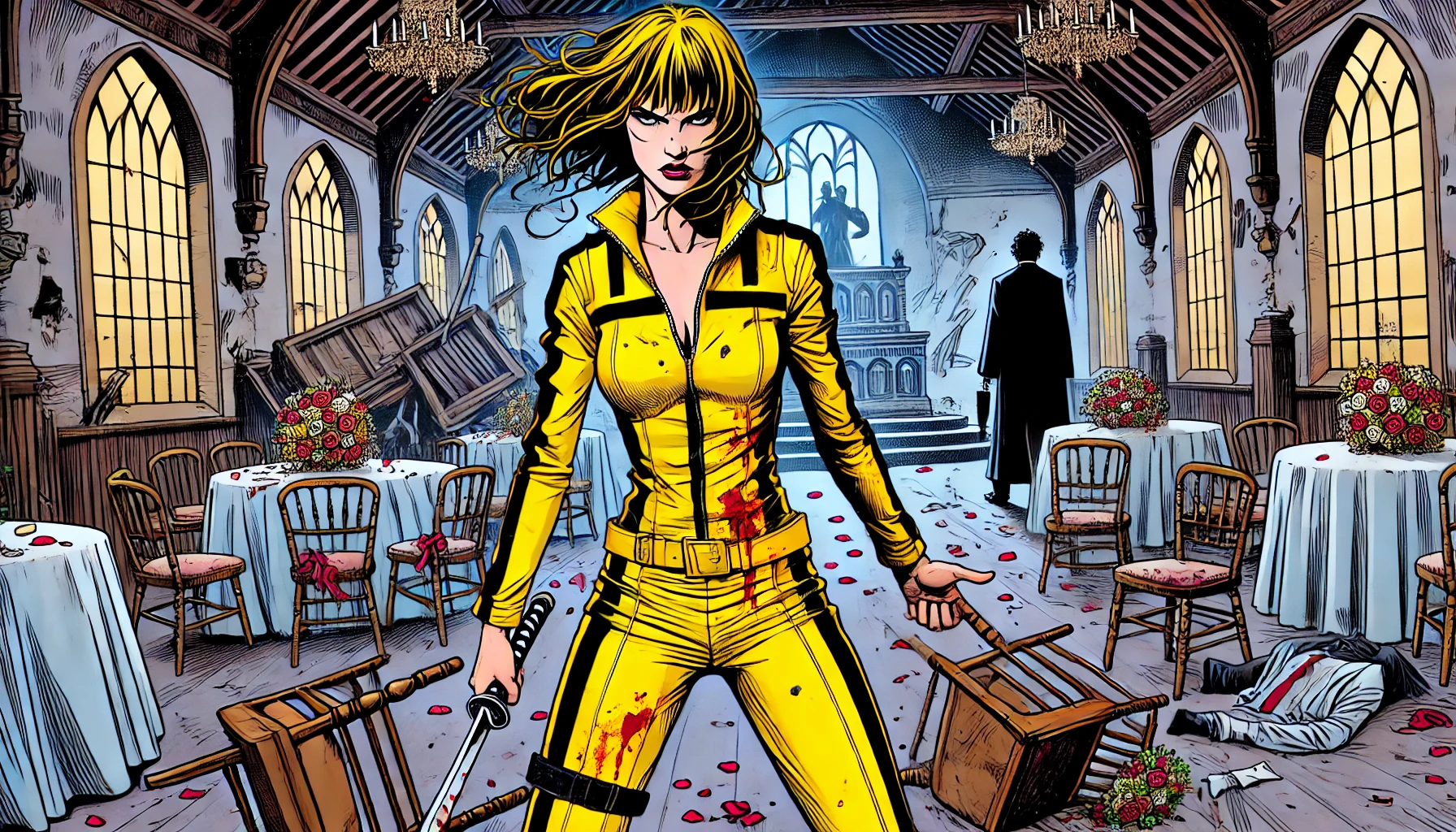
- The repeated use of the color yellow, particularly in the Bride’s iconic tracksuit, symbolizes both her rebirth and her unwavering resolve.
- Morality and Ambiguity:
- The films delve into the ambiguity of moral justice, questioning whether the Bride’s pursuit of revenge is justified or merely a perpetuation of the cycle of violence.
- Tarantino leaves the moral judgment to the audience, presenting the characters’ actions in shades of grey rather than clear-cut right or wrong.
Cinematic and Cultural References
- Genre-Blending:
- Kill Bill is a pastiche of various genres, including martial arts films, spaghetti Westerns, blaxploitation films, and grindhouse cinema. Tarantino’s blending of these genres is both a tribute and a critique, examining the conventions of each while subverting expectations.
- The films are rich with references to cinema history, from Bruce Lee’s Game of Death to Sergio Leone’s The Good, the Bad and the Ugly, and beyond.
- Intertextuality:
- Tarantino’s use of intertextuality is a hallmark of his style, with characters, dialogue, and scenes that reference or echo other works of cinema. This not only adds layers of meaning but also invites the audience to engage with the film on a deeper, more analytical level.
- The films also comment on their own artifice, with moments that break the fourth wall or play with genre conventions, reminding the audience of the constructed nature of cinema.
Influence on Cinema:
- The films have influenced a generation of filmmakers, particularly in their approach to genre-blending, stylized violence, and the use of non-linear narratives.
- Kill Bill also played a significant role in popularizing martial arts and samurai aesthetics in Western cinema, contributing to a resurgence of interest in these genres.
- Quentin Tarantino’s Kill Bill Vol. 1 and Vol. 2 stand as monumental entries in the pantheon of modern cinema. They are dual narratives that deconstruct and reimagine the genre of film. Together, they form a relentless exploration of revenge, identity, and the ethics of violence, executed with a style that is as exhilarating as it is intellectually provocative.
- At its core, Kill Bill is a revenge saga—one of the oldest tropes in storytelling. But in Tarantino’s hands, this archetypal narrative is dissected and reconstructed. The Bride, played by Uma Thurman, embodies vengeance with a singular purpose that borders on the existential. Her journey is not merely about retribution; it is an odyssey toward reclaiming her identity, a quest to redefine her existence that was violently taken from her.
- The first volume is a kinetic explosion of violence, where the choreography of action sequences becomes a language of its own. Here, revenge is visceral, almost ritualistic. The exaggerated bloodshed, stylized in a manner reminiscent of Japanese samurai films and spaghetti Westerns, is a commentary on the spectacle of violence in cinema. Tarantino’s use of pastiche is not mere homage but a critical dialogue with the genres he references. Each swing of the sword, every drop of blood, is a step deeper into the psyche of the Bride, where violence is both the means of liberation and a chain that binds her to her past.
- Volume 2 shifts gears, offering a contemplative counterpoint to the first film’s frenetic pace. The violence here is more psychological, the confrontations more intimate. Tarantino unravels the mythos he built in the first volume, exposing the vulnerabilities beneath the Bride’s relentless exterior. The narrative’s structure—non-linear, fragmented, yet meticulously crafted—mirrors the fragmented psyche of the protagonist, a woman piecing together the shattered remnants of her life.
- In examining the ethics of violence, Kill Bill challenges the audience to question the morality of the Bride’s quest. The film does not offer easy answers; it revels in ambiguity. Tarantino presents violence as an act of empowerment and a source of profound tragedy. The Bride’s triumphs are bittersweet, her victories laced with the loss of innocence and the perpetuation of the cycle of violence she seeks to escape. The duality of her character—both the victim and the perpetrator—reflects the complex nature of vengeance, where the line between justice and revenge is blurred beyond recognition.
- The Bride’s journey is also a search for identity. Throughout the two volumes, her name is withheld from the audience, a deliberate act by Tarantino to dehumanize her, to reduce her to a mere instrument of vengeance. Only when she confronts Bill in the final act is her actual name revealed, symbolizing her reclamation of identity. The revelation is anticlimactic yet profound, underscoring the futility of her quest. The Bride’s actual battle is not with Bill but with herself, her struggle to reconcile the person she was with the one she has become.
- Tarantino’s narrative structure emphasizes this fragmented identity with its elliptical storytelling and temporal shifts. The Bride is a woman in pieces; her story is told out of order, much like her life. The fractured timeline is not just a stylistic choice but a reflection of the disjointed nature of memory and trauma. Tarantino’s approach to storytelling here is almost postmodern, deconstructing the traditional linear narrative to mirror the complexity of his protagonist’s inner world.
- Beneath the blood-soaked surface of Kill Bill lies a philosophical inquiry into the nature of violence and its impact on the human soul. The film is as much about the consequences of violence as it is about the act itself. Tarantino’s use of dialogue, particularly in the second volume, delves into existential themes, with Bill serving as a quasi-philosopher, challenging the Bride’s—and, by extension, the audience’s—perceptions of morality and justice. His monologue on Superman is not just a meditation on comic book lore but a reflection on the duality of human nature, the masks we wear, and the roles we play.
- Kill Bill Vol. 1 and Vol. 2 are more than just revenge thrillers; they are cinematic explorations of the human condition. In his signature style, Tarantino blends genre conventions with philosophical musings, creating a work that is as intellectually stimulating as it is viscerally thrilling. The films challenge the viewer to confront their perceptions of violence, identity, and morality, offering no easy resolutions but rather an invitation to ponder the complexities of these themes long after the credits roll.
- Kill Bill is a tale of redemption—not in the traditional sense, but in the reclamation of the self. The Bride’s journey is one of self-discovery, where violence is both the path and the obstacle, leading to an inevitable confrontation with her enemies and her own humanity. This depth, this willingness to engage with the darker aspects of the human psyche, elevates Kill Bill from mere genre fare to a work of cinematic art.