

Title: Bharat
Release Date: June 5, 2019
Director: Ali Abbas Zafar
Producers: Atul Agnihotri, Alvira Khan Agnihotri, Bhushan Kumar, and Krishan Kumar
Plot Summary: The film follows the life of Bharat, a man who witnesses and experiences key moments in India’s history from the Partition of 1947 to the present day. The story is told through Bharat’s personal journey, reflecting the socio-political changes in India over seven decades.
Adaptation: Bharat is an official remake of the 2014 South Korean film Ode to My Father, directed by Yoon Je-kyoon.
Themes: The movie explores themes of patriotism, family bonds, resilience, and personal sacrifice, intertwined with India’s post-independence history.
Cinematography: Marcin Laskawiec
Editing: Rameshwar S. Bhagat
Runtime: 155 minutes
Ali Abbas Zafar’s Bharat attempts to weave the expansive tapestry of post-independence India through the lens of one man’s journey. Starring Salman Khan in the titular role, the film aspires to be both a sweeping epic and an intimate character study. However, in trying to balance these grand ambitions, Bharat often falters, delivering a narrative that is sometimes incoherent and thematically muddled.
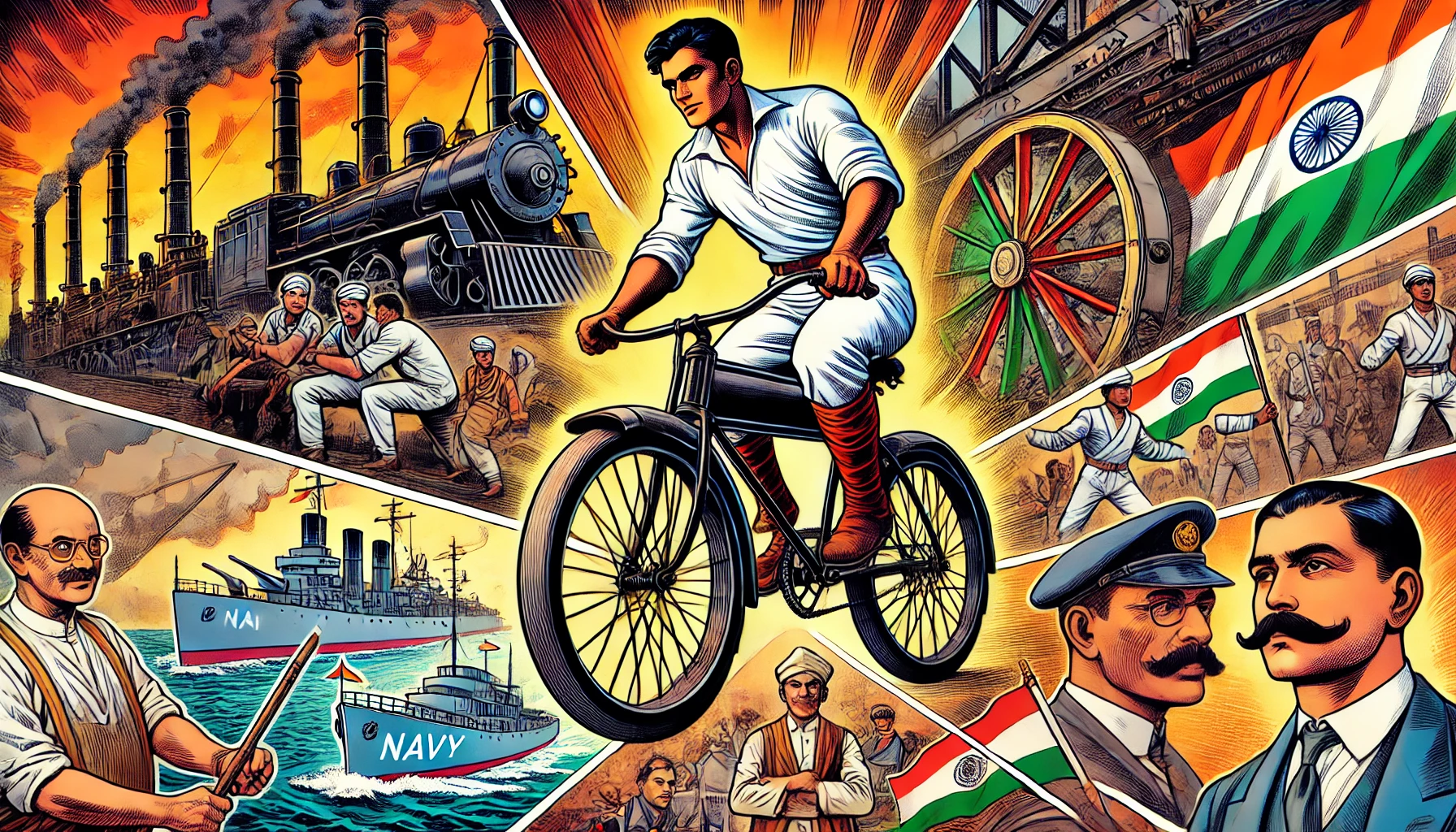
The film’s narrative structure spans seven decades and is its most ambitious yet problematic aspect by choosing to encapsulate key moments of Indian history—Partition, the rise of the oil economy in the Middle East, and economic liberalization—Bharat ostensibly aims to chart the evolution of both the nation and its people. However, this sweeping historical scope feels more like a series of vignettes than a coherent narrative. Each historical moment is treated superficially, more as a backdrop for Salman Khan’s character to exhibit his heroism than an opportunity for critical reflection.
The depiction of these events often feels sanitized, lacking the grit and complexity that these moments deserve. For instance, the Partition, a period marked by unimaginable trauma, is glossed over and reduced to a mere plot device rather than an event worthy of deeper exploration. The film fails to capture the true horror and human suffering of the Partition, instead presenting a more sanitized and palatable version of history. This reluctance to engage critically with history is emblematic of the film’s broader issues—Bharatwants to pay homage to India’s past without confronting its painful complexities.
At the heart of Bharat is Salman Khan’s portrayal of a man whose life mirrors the nation’s trajectory. Yet, despite the film’s efforts to craft a multi-faceted character, Bharat remains frustratingly one-dimensional. Khan’s performance oscillates between the stoic and the melodramatic, often leaning on his star persona rather than the emotional depth required for such a role. This is particularly evident when the film demands introspection—a quality conspicuously absent in Khan’s portrayal.
The supporting cast, including Katrina Kaif as Kumud and Sunil Grover as Vilayti, are reduced to satellites orbiting around the central character. While pivotal to the narrative, their roles lack the development necessary to make them feel integral to Bharat’s journey. Kumud, in particular, is emblematic of the film’s problematic gender politics. Despite being portrayed as a strong, independent woman, her character ultimately reinforces Bharat’s heroism rather than challenge or complicate it. The film’s treatment of Kumud and other female characters reflects a traditional and stereotypical view of women’s roles in Indian society, which may be disappointing to viewers seeking more progressive and nuanced portrayals.
Bharat is a remake of the 2014 South Korean film Ode to My Father, which similarly chronicles a man’s life against significant historical events. While Ode to My Father is lauded for its poignant exploration of loss, sacrifice, and resilience, Bharat struggles to capture the same emotional depth. The original film’s exploration of personal and national identity is both nuanced and emotionally resonant, drawing viewers into the protagonist’s internal conflicts and the broader socio-political context.
In contrast, Bharat dilutes these themes, focusing instead on spectacle and star power. The emotional resonance of Ode to My Father is often lost in translation and replaced by melodramatic sequences that feel disconnected from the historical gravity they are meant to convey. Where the original film’s protagonist is an everyman whose struggles reflect the collective pain of a nation, Bharat’s character is elevated to an almost mythic status, his experiences more about reinforcing his heroism than exploring the complex interplay between personal and national identity.
At its core, Bharat attempts to grapple with the notion of personal and national identity. The film posits Bharat as a metaphor for India, a man whose life is inextricably linked with the nation’s fate. This parallel, while conceptually intriguing, is executed clumsily. The film’s philosophical undertones are often drowned out by its need to cater to commercial sensibilities, resulting in a narrative more interested in spectacle than substance.
The idea of a man embodying the spirit of a nation is potent, but it fails to explore this fully. The film touches on themes of duty, sacrifice, and resilience, yet it never delves into the complexities that these concepts entail. Instead, it offers a superficial exploration of these ideas, more concerned with affirming the protagonist’s virtue than questioning the costs of such an existence.
Visually, Bharat is a polished film, with Zafar’s direction ensuring that each era is rendered with an eye for detail. Yet, this attention to style often comes at the expense of narrative depth. The film’s pacing is uneven, with specific segments dragging on while others are hurriedly glossed over. This inconsistency in pacing can disrupt the audience’s engagement, making it difficult to fully immerse in the narrative. This further detracts from the film’s attempt at a cohesive narrative, leaving the audience with a disjointed experience.
The music and choreography, while entertaining, often feel at odds with the film’s supposed gravitas. The frequent musical interludes disrupt the narrative flow, serving more as showcases for Khan’s star power than as integral components of the story. This reliance on formulaic Bollywood tropes undermines the film’s ambition to explore identity and history seriously.
Bharat aspires to greatness but is ultimately undone by its own contradictions. It seeks to be a poignant exploration of identity, history, and nationhood, yet it remains trapped within the confines of commercial cinema. The film’s inability to reconcile its philosophical ambitions with its need to cater to the masses results in an intellectually unsatisfying and emotionally hollow work.
Bharat is more a celebration of Salman Khan’s stardom than a critical examination of India’s post-independence journey. It invites contemplation but provides little substance for meaningful reflection. By failing to capture the emotional depth and narrative coherence of Ode to My Father, Bharat becomes a disjointed retelling rather than a profound exploration. In trying to be both epic and intimate, historical and personal, Bharat ultimately achieves neither, leaving behind a narrative as fragmented and unresolved as the history it seeks to portray.