



Over the past twenty-five years, the Best International Feature Film category has shown a clear structural pattern. Festival premieres are a primary determinant of awards visibility. Approximately eighty-five percent of nominees screened at one of four festivals: Cannes, Venice, Toronto, or the Berlinale. Among winners, the figure rises to ninety-six percent. Cannes alone accounts for nearly half of all winners in this period.
These outcomes reflect how the global film ecosystem is organised. Major festivals function as early-stage selection mechanisms. A Competition slot at Cannes or a top prize at Venice signals quality, but more importantly, it establishes positioning. Distributors, critics, and awards strategists align quickly around these signals. Campaigns are built on that foundation, often months before formal awards season activity begins.
Cannes has been the most consistent driver of this pipeline. Films such as Amour, Parasite, and The Zone of Interest illustrate the trajectory. Each premiered in Competition, secured strong critical response, and entered the awards cycle with defined narratives. The Cannes premiere creates concentrated visibility. Coverage from international press, acquisition activity, and early critical consensus provide sustained momentum. By the time Academy voters engage, these films are already embedded within the global discourse.
Venice plays a complementary role. Its late-summer timing positions it closer to the awards calendar. Roma is a clear example. The Golden Lion established priority status for the film within the season. Toronto contributes through audience validation and North American exposure. While it lacks a formal jury structure, its impact on distribution strategy and public reception is significant. The Berlinale contributes less frequently to winners in this category but remains part of the same validation network.
The mechanism at work is continuity. Festival premieres initiate a multi-month visibility cycle. Films move from premiere to critical circulation, then into distribution and targeted campaigning. Each stage reinforces awareness. Awards outcomes tend to favour films that have maintained consistent presence across this cycle. Films that bypass this circuit face structural disadvantages in terms of visibility, access, and narrative formation.
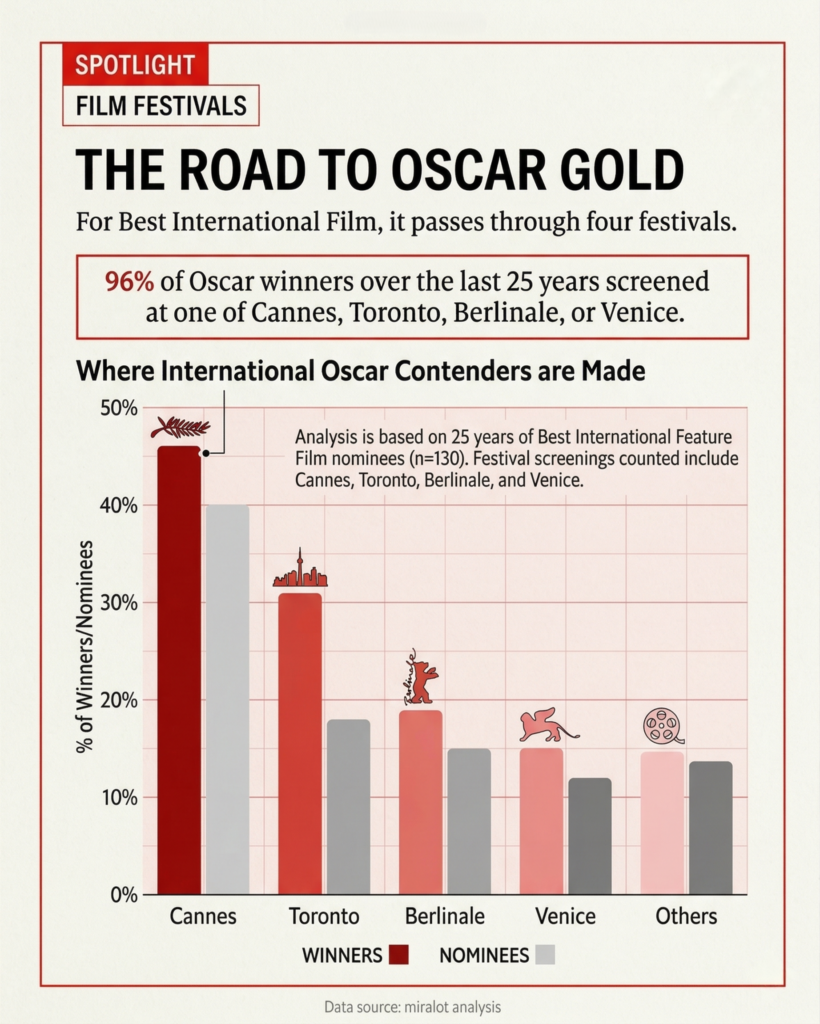
The 2026 Oscar lineup provides a concentrated case. All five nominees originated from major festivals. Four were from Cannes Competition: It Was Just An Accident (Palme d’Or), Sentimental Value (Grand Prix), The Secret Agent (Best Director and Best Actor), and Sirāt (Jury Prize). The fifth nominee, The Voice of Hind Rajab, won the Grand Jury Prize at Venice. Each film entered the awards season with established credentials. This level of alignment between festival outcomes and Oscar nominations is uncommon but consistent with long-term trends.
The win for Sentimental Value reflects this structure. The Grand Prix positioned the film within the upper tier of the Cannes lineup. Subsequent distribution and campaign decisions leveraged that positioning. The film maintained visibility across the season and converted that into Academy support. This sequence aligns with prior winners that followed similar festival-to-Oscar trajectories.
The Palme d’Or has translated into an Oscar win only twice in this period, with Amour and Parasite. The conversion rate is limited, but Palme d’Or winners consistently enter the awards cycle as top-tier contenders. In the case of Jafar Panahi’s It Was Just An Accident, the combination of festival recognition and external context strengthens its competitive position, even where conversion is not guaranteed.
From an industry perspective, these patterns indicate that festival strategy is a core component of awards planning. Premiere selection, festival placement, and timing influence the entire downstream process. Early positioning affects distribution deals, media coverage, and voter awareness. Campaign resources are deployed more efficiently when supported by prior festival validation.
The concentration of nominees within a small set of festivals also raises structural considerations. Films that do not premiere within this circuit face reduced access to critical mass and industry attention. Alternative pathways exist, but they require significantly higher investment in marketing and outreach to achieve comparable visibility.
The data supports a clear conclusion. Festival placement is a leading indicator of Oscar performance in the Best International Feature category. The relationship is not absolute, but it is consistent enough to inform strategy. Where a film premieres influences how it is positioned, how it is perceived, and how effectively it can sustain a campaign through the awards cycle.